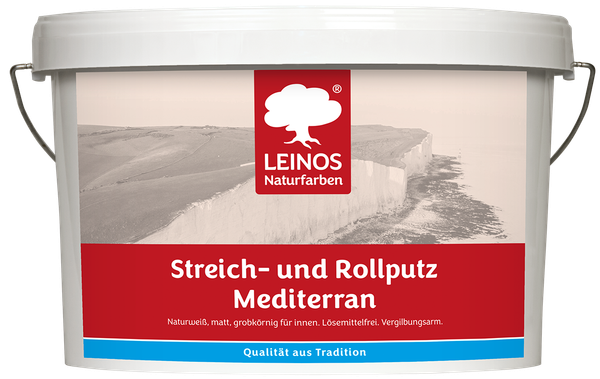
... fine grain for fine surfaces!
Would you like to give your old walls a new texture or are your new plastered surfaces simply too smooth and expressionless? Or are you perhaps bothered by the fact that your new drywall surfaces are immediately perceived as such?
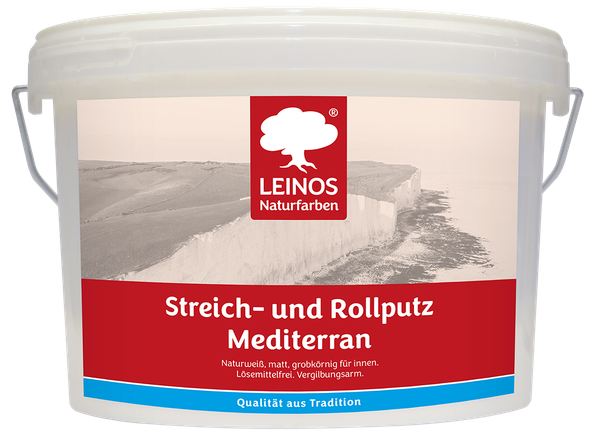
In all cases, you should try LEINOS Plaster-Effect Paint: With its fine grain of white marble powder, it conjures up a lively, textured surface with the character of plaster in an instant. Due to its high degree of whiteness and its filling capacity, a thick application with a roller or brush is often enough and your wall is finished. By the way: LEINOS Plaster-Effect Paint is also an excellent substrate for the LEINOS glazing technique and can be painted with LEINOS Pigment Concentrates can be tinted as desired!
... fine grain for fine surfaces!
Would you like to give your old walls a new texture or are your new plastered surfaces simply too smooth and expressionless? Or are you perhaps bothered by the fact that your new drywall surfaces are immediately perceived as such?
In all cases, you should try LEINOS Plaster-Effect Paint: With its fine grain of white marble powder, it conjures up a lively, textured surface with the character of plaster in an instant. Due to its high degree of whiteness and its filling capacity, a thick application with a roller or brush is often enough and your wall is finished. By the way: LEINOS Plaster-Effect Paint is also an excellent substrate for the LEINOS glazing technique and can be painted with LEINOS Pigment Concentrates can be tinted as desired!
Substrate and preparation
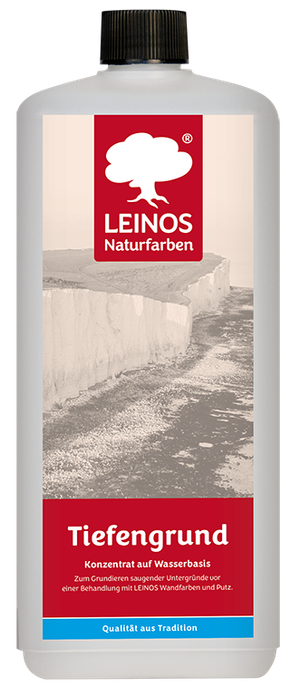
The substrate must be chemically neutral, dry, solid, clean, free of grease and dust and free of penetrating substances. Highly absorbent, unstable substrates and sanding plasters must be treated with LEINOS Water-based Deep Sealer be primed.
Processing
It is generally applied with a brush or roller at a room and surface temperature above 15 °C. When applying with a roller, a uniformly textured, grainy surface is obtained. Animated structures are achieved by applying with a brush, e.g. in the form of "horizontal eights".
New, untreated plaster and drywall surfaces:
These are, for example, gypsum, lime or cement plaster, gypsum plasterboard, gypsum fibreboard or concrete. The aforementioned substrates must be treated to reduce the strong absorbency with LEINOS Water-based Deep Sealer must be primed. Then apply 1 to 2 coats of LEINOS Plaster-Effect Paint, depending on the coverage and desired texture.
Old paintwork and wallpaper:
Existing emulsion paints on plaster, plasterboard etc. must adhere firmly and can be reworked with LEINOS Plaster-Effect Paint without prior priming. Old wallpaper that has already been painted once or several times with emulsion paint must be checked for good adhesion and re-applied if necessary. Heavily soiled old coatings should be cleaned. Old coats of distemper and flaking paint must be completely removed. Dense, barely absorbent substrates such as latex or lacquer coatings must be sanded or leached very thoroughly. In general, no primer is required for existing, stable old coatings unless the old coating must be completely removed.
TIPS & TRICKS:
Saliva test:
The "saliva test" can be used to determine whether an old coat of paint is distemper or another reversible paint: Put a little saliva on a fingertip and rub over the surface with light pressure. If the saliva discolours towards the substrate colour, the entire old coating must be completely removed or washed off the substrate.
Rich application:
Do not be too careful and apply LEINOS Plaster-Effect Paint generously if you want high filling power or a stronger structure. LEINOS Plaster-Effect Paint remains compact and hardly falls off. You can also combine them: If you want to work quickly, apply the material with a roller and finish with a brush.
Drying time
Approx. 16-24 hours. Completely dry and loadable after approx. 1 week. This system requires sufficient amounts of atmospheric oxygen for drying. Therefore, ensure good ventilation, e.g. with a fan in stagnant air, to avoid odours.
Consumption
Approx. 200-300 ml/m² per application, may vary depending on the absorbency of the substrate.