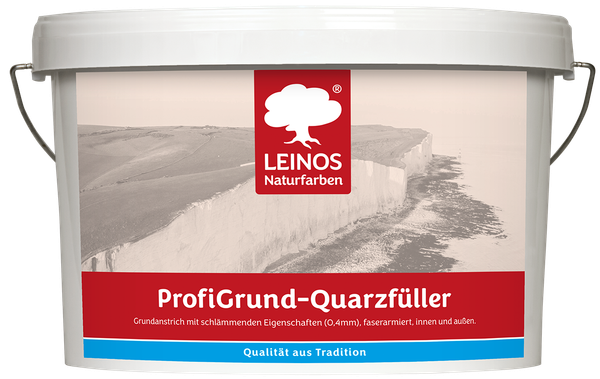
Ideal primer and slurry coat for full-surface reworking of hairline cracks, plaster repairs and fine structural differences. Also for load-bearing old coats and ETICS (external thermal insulation composite systems). As a subsequent coat LEINOS ProfiSol fine facade paint or LEINOS UniverSil fine facade paint recommended.
Ideal primer and slurry coat for full-surface reworking of hairline cracks, plaster repairs and fine structural differences. Also for load-bearing old coats and ETICS (external thermal insulation composite systems). As a subsequent coat LEINOS ProfiSol fine facade paint or LEINOS UniverSil fine facade paint recommended.
Substrate and preparation
Stir and sieve thoroughly before use to remove dried paint particles from the edge of the bucket or lid. All surfaces must be professionally prepared in accordance with VOB Part C DIN 18363 or the BFS data sheets. Holes and break-outs must be repaired with a suitable material with the same structure and must be completely dry before further processing. Unsafe substrates must be assessed individually and sample areas created for the paint structure.
Unsuitable substrates: Wood and wood-based materials, clay, plaster, plastics, substrates on which water cannot run off and dry well, surfaces exposed to salt, generally non-load-bearing substrates, as well as glossy and plasto-elastic substrates.
Processing
LEINOS ProfiGrund-Quarzfüller is designed as a primer and must be applied with LEINOS ProfiSol fine facade paint or LEINOS UniverSil fine facade paint can be painted over. By adding 10-20 % LEINOS Profi-Fixativ, the coating is adjusted to the application and substrate as required. The coating is applied with a brush, roller or airless device. Application with a brush is recommended. Carefully fill in hairline cracks and smooth the transitions well.
Drying time
Process for at least 12 hours, not below +8 °C. Do not apply LEINOS ProfiGrund-Quarzfüller in direct sunlight or on heated substrates. Protect fresh coats from rain.
Consumption
Average coverage approx. 0.25-0.4 kg/m² on smooth, normally absorbent substrates.